
Gardening with the moon: does it work? An honest look at the evidence
Published by Germie in Moon gardening the 05/11/2026 at 16:36

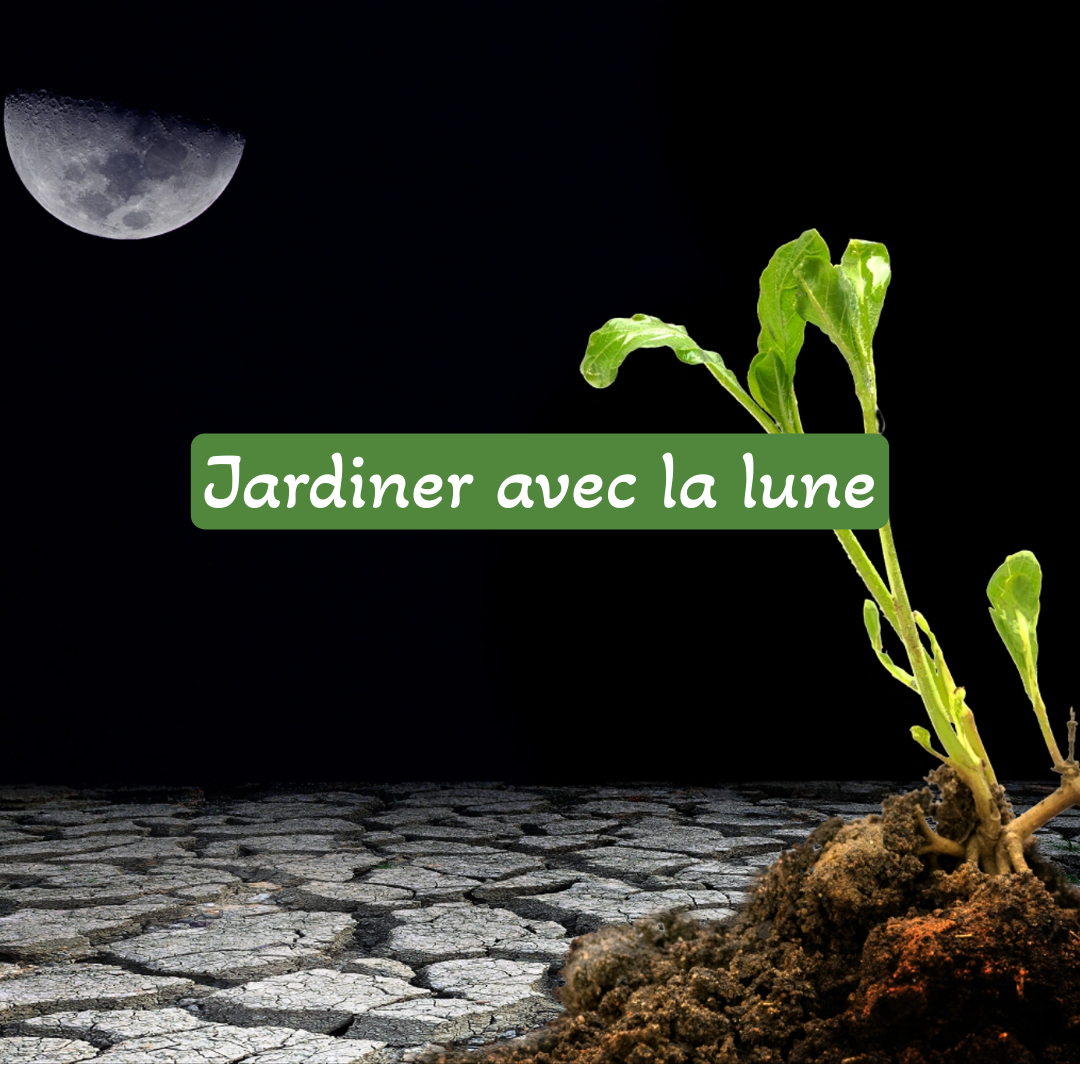
"Gardening with the moon" may be the most widespread — and most divisive — practice in the vegetable garden. Between calendars promising bigger harvests and skeptics calling it superstition, it is hard to know where you stand. This article sorts it out honestly: first the exact rules of the lunar tradition, then the real state of the evidence — and finally what a pragmatic gardener can take from it.
Two different lunar cycles — that popular calendars blur
First point that most garden-center calendars muddle: the "waxing" moon and the "ascending" moon are not the same cycle. Waxing and waning describe the lit phase — the visible quarter of Moon growing then shrinking — over a cycle of about 29 days, 12 hours and 44 minutes. Ascending and descending describe the Moon's height in the sky, rising then sinking over a cycle of 27 days, 7 hours and 43 minutes.
The little-known consequence: these two rhythms are not coordinated. The Moon can be climbing the sky while waning — and vice versa. Some months offer no window combining all the "ideal" criteria at once, which is why two lunar calendars can contradict each other: they don't keep the same cycles.
Root, leaf, flower and fruit days
The tradition's second pillar: the Moon passes in turn in front of the zodiac's twelve constellations, staying before each for one and a half to three and a half days. Each constellation is tied to an element, and the element to a type of vegetable:
- Root days (Earth constellations: Taurus, Virgo, Capricorn) — carrot, beet, radish, turnip, potato, garlic.
- Leaf days (Water constellations: Cancer, Scorpio, Pisces) — lettuce, spinach, cabbage, leek, herbs.
- Flower days (Air constellations: Gemini, Libra, Aquarius) — ornamental flowers, but also artichoke and broccoli.
- Fruit and seed days (Fire constellations: Aries, Leo, Sagittarius) — tomato, squash, bean, pea, strawberry.
Then comes the ascending/descending rhythm: under an ascending moon, sap supposedly "rises" into the aerial parts — you sow and graft. Under a descending moon it supposedly flows back to the roots — you plant, transplant, prune and take cuttings. Tradition also advises against gardening at lunar nodes, perigee and apogee — the markers our 2026-2027 lunar garden calendar flags day by day with real astronomical times.
What the evidence shows: the proponents' own admission
This is the most enlightening — and least-known — point. The experiments invoked by the tradition (radish trials, bean trials) were never published with a verifiable methodology: no double-blind design, no control group, no independent replication. Even lunar-gardening guide authors frankly admit it: their home trials may contain bias, some show a correlation, others none — and missing a lunar day has never made a vegetable garden fail.
On the science side, the rule is simple: whoever claims an effect must demonstrate it in a published, peer-reviewed study — it is not for science to prove it doesn't exist. On moonlight specifically, the matter is settled: full moonlight is thousands of times too weak to affect photosynthesis. It influences some nocturnal insects, not plants.
So, useful or not? The honest use of the lunar calendar
Our position: lunar gardening is a planning tradition, not a proven agronomic technique. That doesn't make it a waste of time — what is established and genuinely useful:
- It structures the work — spreading sowing, pruning and harvests across the month rather than doing everything at once.
- It makes you observe your garden — following it day after day mechanically improves gardening quality.
- It carries a culture — four centuries of farmers' calendars, a heritage with its own value.
But if one variable truly decides the success of your seedlings, it is not the Moon's position: it is substrate temperature (20 to 26°C for most seeds — a heat mat stabilizes it), light (14 to 16 hours a day — an LED grow light supplies it) and the season calendar. Our measured heat-mat + LED protocol and the winter sowing calendar detail these levers — the only ones backed by measured figures.
Want to test it yourself? Follow the 2026-2027 lunar garden calendar alongside your seedlings under a germination kit — and judge for yourself.
By card and PayPal
For orders over €45
Our goal: 100% satisfaction
More information