Tomato Seedlings: When and How to Sow Them Successfully
Published by Germie in Vegetables the
05/11/2026 at 12:04
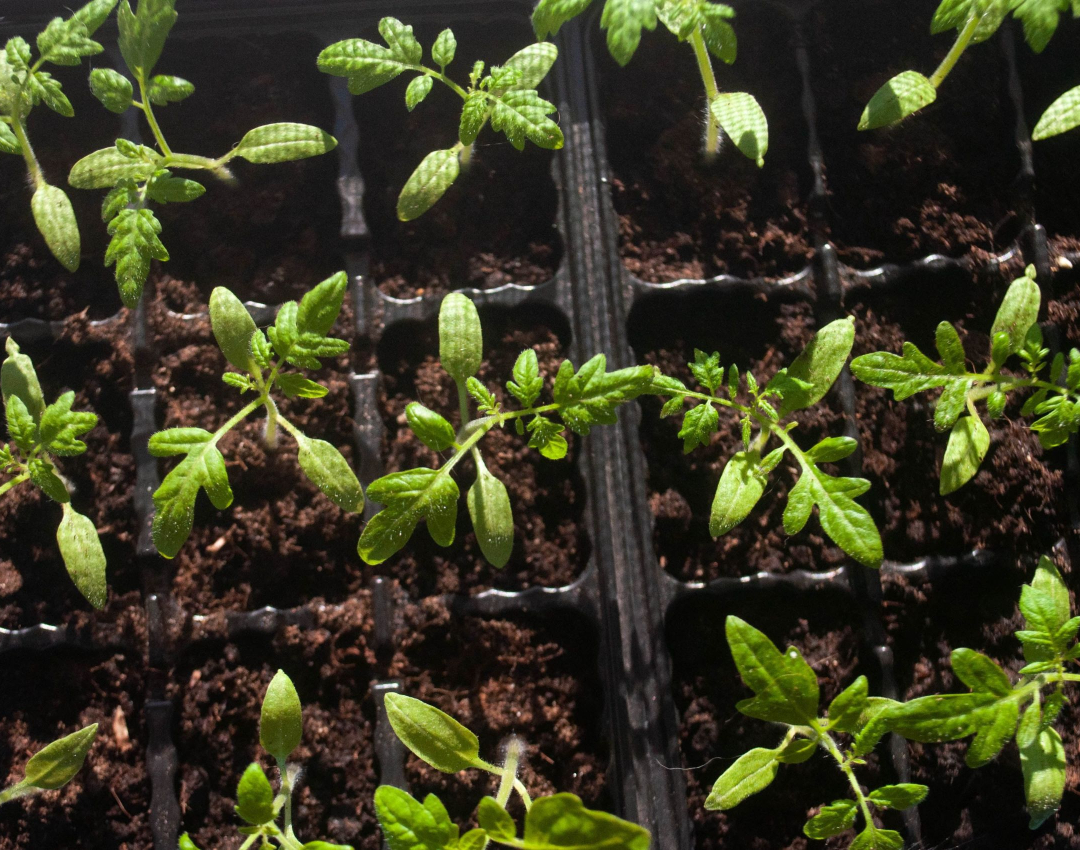
The tomato is the indoor sowing par excellence: demanding on heat, greedy for light, but very reliable once three settings are respected. This guide details dates, temperatures, transplanting and hardening off — plus the mistakes that kill seedlings.
When to sow tomatoes?
- The rule: count back from planting out. Sow 5–6 weeks before the expected transplant date — gardeners commonly start indoors 4–6 weeks before the last frosts; the market-gardener method goes back 7–9 weeks for a production plan.
- In dates: between 15 February and late March under cover with bottom heat, or mid-March for a classic start. In a greenhouse or conservatory, a late-February sowing gives the best chance of ripe fruit by late June.
- Too early = trap: sowing too early in the year produces drawn-out, spindly seedlings if light is lacking early in the season. Early-January sowing without a lamp yields unsellable plants.
Temperatures: the setting that decides everything
- Germination: tomato seeds germinate best between 21 and 32 °C, with an optimum around 29 °C; at a steady 18–24 °C, expect emergence in about five days.
- Bottom heat: a substrate temperature of 21–27 °C is ideal, especially when heated from below — exactly the job of a heating mat, which lifts the compost 5–10 °C above ambient.
- After emergence, come back down: young plants grow best between 16 and 21 °C. A plant held at 25 °C day and night will etiolate for sure.
- Emergence time: 6–10 days under normal conditions, 8–11 days with gentle heat — noticeably longer if the substrate is cold.
The sowing move
- Depth: the reference range runs 5–12 mm — 6 mm, two seeds per pot, covered with fine sieved compost.
- Moisture until emergence: cover the container with a dome or clear film (or a plastic bag), then remove it as soon as seedlings appear.
- One real watering: moisten thoroughly before covering — often the only watering needed for the whole germination. Afterwards: keep the soil fresh, never soggy.
Light: where everything is decided after emergence
- Duration: 12–16 hours of light a day — a winter south window is not enough for proper growth.
- Lamp-to-plant distance: for fluorescent tubes, keep the source 2.5–5 cm above the foliage to avoid thin stems; for LEDs, the reference distance is 10–20 cm. The horticultural LED lamp adjusts as they grow.
- The diagnosis: the first sign of insufficient light is seedlings leaning toward the window with thin, long stems. Etiolation = more light, not more water.
Transplanting: the tomato's special feature
- When: transplant about two weeks after emergence, when plants show two or three good leaves — into 8–10 cm pots.
- Bury the stem — the tomato's strength: replant burying most of the stem, up to the first leaves; adventitious roots form along the buried section. A stretched plant catches up at transplanting this way.
- The extra trick: brushing the top of the plants daily once they reach 8 cm strengthens the stem and gives short, sturdy plants. Another tip: lay the pot on its side when the seedling is 10–12 cm tall to multiply roots.
Hardening off and planting out
- One to two weeks of transition: before planting out, stop fertiliser, reduce water and take the plants out progressively — half an hour in light shade on day one, a full day outside by day seven, bringing them in each evening.
- The safety threshold: soil must be at least 13–16 °C and nights should not drop below 7 °C — the traditional rule waits for mid-May, after the last frosts.
- The ideal plant: sturdy, flowerless, dark green foliage, 15–25 cm tall. Plant deep — up to the first leaf — spacing holes 40–50 cm (60–90 cm if left unstaked).
- Beware the cold snap: a newly planted tomato survives 3 °C but will never crop to full potential afterwards — surviving is not producing.
The two seedling killers
- Damping-off: a soilborne disease that kills young plants by constricting the stem just above the soil — fungi (Pythium, Fusarium, Phytophthora) favoured by waterlogged, nitrogen-rich substrate. Prevention: disinfect reused pots and trays, sow thinly to let air circulate, ventilate seedlings and measure watering.
- Etiolation: covered above — insufficient light + excessive heat. Leggy seedlings also become more susceptible to damping-off.
And your own seeds?
Good news: tomato seed has no dormancy and sprouts without pretreatment; its gelatinous coating disappears naturally through fermentation in the soil. To save your own: ferment the seeds 10 h at 30 °C (or 3–4 days at 18–20 °C), then dry them away from the sun around 20 °C. Viability: 4 years easily in good cool storage, up to a dozen years under controlled conditions.
Where to start?
The trio covering the three settings: the complete seedling kit (indoor greenhouse + LED + heating mat), the heating mat for bottom heat and the LED lamp for the daily 14–16 h. Related reading: the winter sowing calendar, seed stratification, and the pepper and eggplant guides, sown at the same time.
Growing calendar
| JAN | FEB | MAR | APR | MAY | JUN | JUL | AUG | SEP | OCT | NOV | DEC | |
|---|---|---|---|---|---|---|---|---|---|---|---|---|
| Sowing | ||||||||||||
| Planting | ||||||||||||
| Harvest |