Growing Morelle de Balbis (litchi tomato): the complete guide
Published by Germie in Vegetables the
05/11/2026 at 16:33
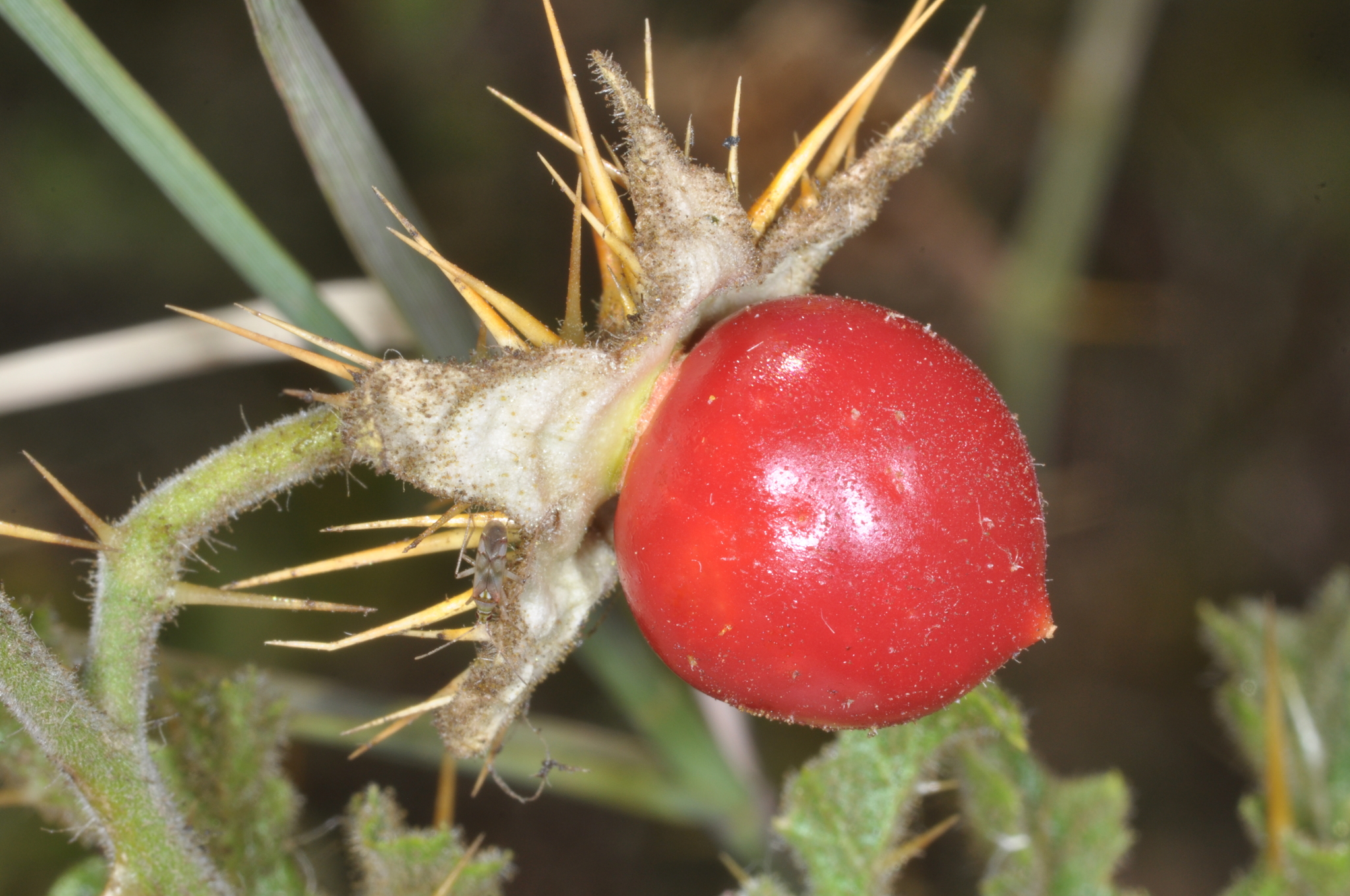
Morelle de Balbis: the litchi tomato making its comeback in the vegetable garden
Morelle de Balbis (Solanum sisymbriifolium), also nicknamed the litchi tomato, is an unusual fruit vegetable. It produces clusters of fruits wrapped in a spiny husk, like that of the chestnut. The plant can exceed 1.50 m in height, with branching stems covered in impressive spines — gloves are essential for handling it. Its deeply cut green leaves, with pale veins that also bristle with spines, give it real ornamental value.
In summer, it produces clusters of white, blue or violet star-shaped flowers — larger than those of the potato or the aubergine, its cousins in the Solanaceae family. In autumn, its bright red fruits, released when the husk opens fully, offer a surprising flavour somewhere between litchi and red berries.
Contents
- Sowing & harvesting calendar
- A little history
- Etymology and nicknames
- Taste and nutritional value
- Subspecies and varieties
- How to grow Morelle de Balbis
- Growing tips
- Successful sowing
- Sowing tips
- Care and harvest
- Tips and tricks
- Crop rotation and companion plants
- Storage and uses
- Diseases and pests
- Latin name: Solanum sisymbriifolium
- Family: Solanaceae
- Order: Solanales
- Genus: Solanum
Sowing & harvesting calendar
| JAN | FEB | MAR | APR | MAY | JUN | JUL | AUG | SEP | OCT | NOV | DEC | |
|---|---|---|---|---|---|---|---|---|---|---|---|---|
| Sowing | ||||||||||||
| Planting out | ||||||||||||
| Harvest |
Green: main period. Yellow: sowing possible as early as February in a heated propagator for a head start. Harvest until the first frosts.
A little history of Morelle de Balbis
Native to South America — mainly Paraguay, Argentina, Uruguay and southern Brazil — Morelle de Balbis grows wild in open areas, even on poor or disturbed soils. It was scientifically described in the early 19th century and named after the Italian botanist Giovanni Battista Balbis.
Introduced to Europe in the 19th century, it was at first confined to botanical gardens and ornamental collections. Its armour of spines and the toxicity of its unripe fruits long hindered its spread. It was its value as a trap crop against potato cyst nematodes — and the novelty of its edible fruits — that earned it renewed interest, especially among permaculture and organic gardening enthusiasts.
Etymology and nicknames
The name "morelle" traditionally designates several species of the genus Solanum. "Balbis" honours Giovanni Battista Balbis (1765–1831), botanist and professor in Turin. The epithet sisymbriifolium means "with sisymbrium-like leaves", an allusion to its deeply cut foliage. Its nickname litchi tomato evokes the flavour of its fruit, whose sweet notes recall those of the litchi.
Taste and nutritional value
The fruits of Morelle de Balbis are eaten only when fully ripe, when the spiny husk opens completely and reveals a bright red berry. The flesh is translucent and juicy, with a highly distinctive aromatic profile: a blend of litchi, plum, raspberry and sometimes sweet cherry tomato. It can be enjoyed raw, cooked or in jams.
Nutritionally, these small berries provide vitamin C, fibre and antioxidant compounds. A healthy little fruit that deserves a place in autumn desserts — provided you never eat the green fruits or the other parts of the plant, which are toxic, as with most nightshades.
Anecdote
Long forgotten outside its native range, Morelle de Balbis was "rediscovered" by organic farmers not for its fruits but for its roots: planted in an infested plot, it attracts potato cyst nematodes whose larvae develop without being able to complete their life cycle. An ecological ally that rids the soil of these parasites without any treatment.
Main subspecies and varieties
Unlike tomatoes, there are no named varieties — gardeners grow the species Solanum sisymbriifolium itself, of which a few loosely differentiated regional variants exist. It should not be confused with its relatives such as Solanum caripense (tzimbalo) or horse nettle (Solanum carolinense), which is not edible — nor with black nightshade (Solanum nigrum), its toxic cousin.
How to grow Morelle de Balbis?
Technical information
- Difficulty: medium (2/3) — mainly because of the spines and the early sowing
- Density: 1 plant per m²
- Life cycle: annual in our climates, perennial in frost-free zones
- Propagation: by seed
- Pollination: self-pollinating
- Weight per 1,000 seeds: about 1.5 to 2 g
- Height: 1 to 1.80 m
Climate and soil
- Climate: a warm-climate plant, grown as an annual in temperate regions; fully frost-tender, it succumbs to the first frosts.
- Soil: it tolerates all soil types but prefers a loose, well-drained soil rich in organic matter. It likes consistent moisture, but not waterlogging.
- pH: neutral, but it tolerates slightly acidic or slightly calcareous soil. A Gardiscan-type soil analyzer lets you check pH and fertility before planting.
- Position: full sun is essential.
Growing tips
| Position | Full sun |
| Watering | Moderate; daily in summer |
| Soil | All soil types (ideally loose and enriched) |
| Foliage | Deciduous |
| Mature height | 150 cm |
| Spacing | 50 cm in all directions |
| Hardiness | Frost-tender — succumbs to the first frosts |
Sowing tips
| Life cycle | Annual (perennial in frost-free zones) |
| Germination time | 7 days at 20 °C (7-21 days depending on conditions) |
| Germination temperature | 20 °C (20-25 °C) |
| Sowing method | In small clusters (a few seeds per pot) |
| Sowing depth | Equal to the size of the seed |
| Container | Pot or tray filled with seed compost |